OSM: Changing Properties of South Atlantic Upper-Ocean Water Masses During the Past 45 Years
Date:
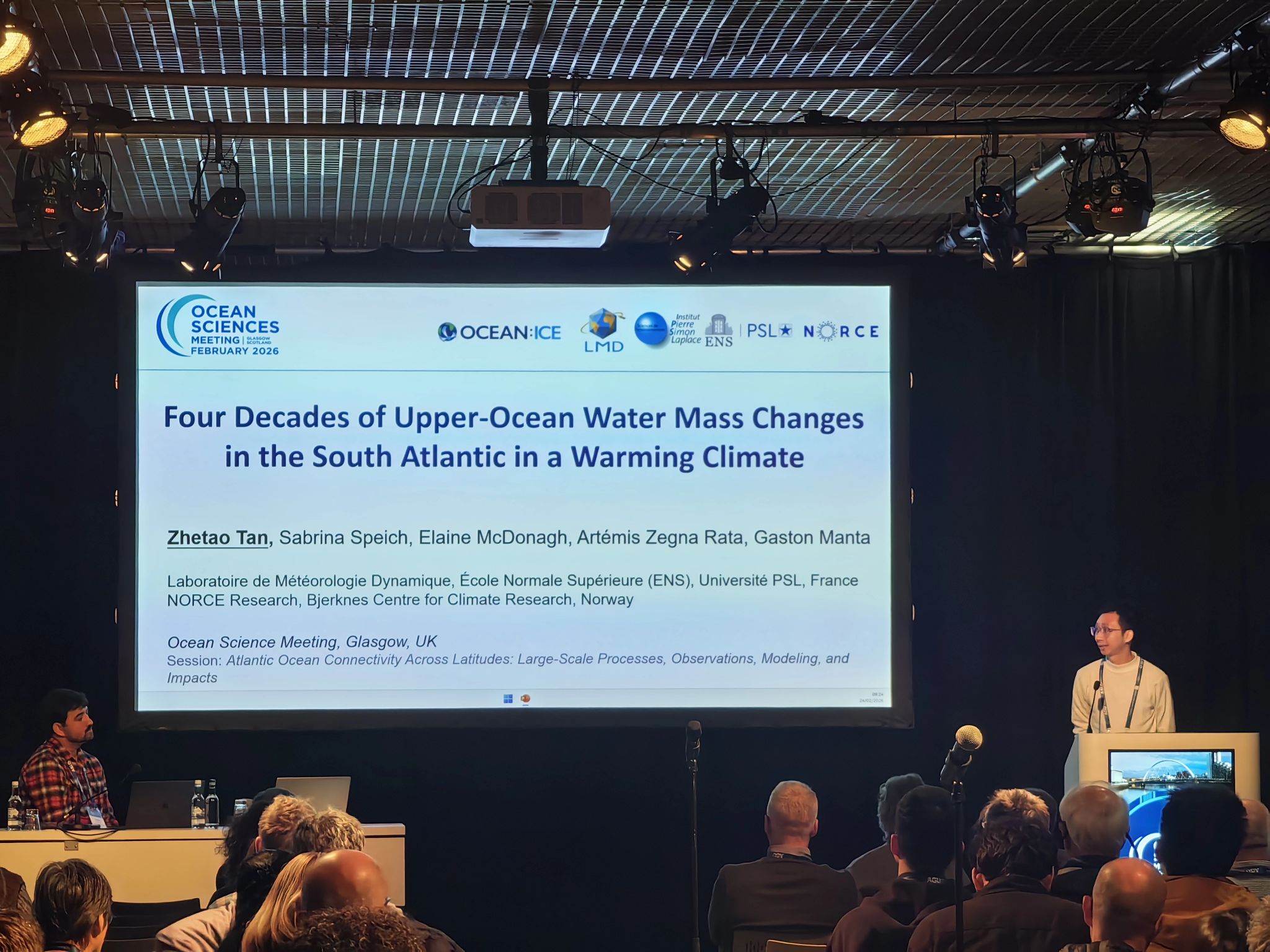
On February 24, 2026, I had the honor to give a talk on the Ocean Science Meeting 2026 with titled ‘Changing Properties of South Atlantic Upper-Ocean Water Masses During the Past 45 Years’
In this presentation, I show the latest progress on the South Atlantic long-term changes in different water masses. Based on the direct observations, we elucidated the phsyical process driving the compound change (temperature coupling with salinity) in response to global warming from the water mass perspective. We also took this opportunity to call attention to the ongoing climate transformations in the Global South, which should be placed in an equal role with the Global North in the ocean science community.
Below is the abstract for this presentation:
Abstract
The South Atlantic plays an important role in regulating Earth’s climate by distributing heat, freshwater, and oxygen into the deep ocean or across basins, and feeding the Atlantic Meridional Overturning Circulation (AMOC). With the ongoing global warming, investigating the changes in the physical state of the South Atlantic such as temperatures, salinity, and circulation is a high-priority topic. Understanding these changes across different depths and water masses is crucial for improving climate projections and assessing key climate impact-drivers (CIDs). The development of the regional ocean observing system in the South Atlantic (e.g., data sampling increased) and the advanced data processing techniques provides us opportunities to investigate the physical state of the South Atlantic since the 1980s.
In this presentation, we will reveal how key South Atlantic upper-ocean water masses have shifted on different timescales (variability and trends) over the past 45 years by analyzing several state-of-the-art observational gridded products, augmented by ship-based section data and rigorous uncertainty estimates. We report notable property changes in upper-ocean water masses in a warming climate: the Antarctic Intermediate Water (AAIW) has become warmer, lighter, and thinner, which is attributed to the significant warming signal propagating from the Subpolar Frontal zone and the Indian Ocean into the South Atlantic basin. The South Atlantic Central Water (SACW) has expanded in volume. We also identified the most critical areas in the redistribution of temperature and salinity across the water masses. In addition, the (inter-)decadal variability of temperature or salinity changes can be detected in the upper-ocean water mass, in spite of the time series exhibiting noise-induced fluctuations. We also report early indications of potential anthropogenic warming signatures in deep waters. This study is the first to use continuous monthly data to assess long-term water mass changes in the South Atlantic, indicating the capacity and ability to reconstruct the historical changes in the South Atlantic pre-Argo era, and thus providing new insights into regional climate dynamics and potential links with AMOC variability.